


The art of expressing oneself without revealing oneself
Artists often explore their creative world through chosen themes: characters, metaphors or objects. But they also reveal something about themselves through seemingly ordinary places or scenes. This indirect approach is often just as subtle and profound as a direct self-portrait.
Portraying oneself is always a challenge, as it involves laying oneself bare. A painted object is almost never neutral; it is imbued with identity, emotion or personal history.
The exhibition from May to June 2026: an exploration of the intimate
For a long time, still life has been a way of expressing oneself without revealing one’s true self. The objects chosen — books, fruit, wilted flowers — become a form of vocabulary, an indirect self-portrait. Places are transformed into mental projections: the room is painted ‘as one feels’ rather than ‘as it is’.
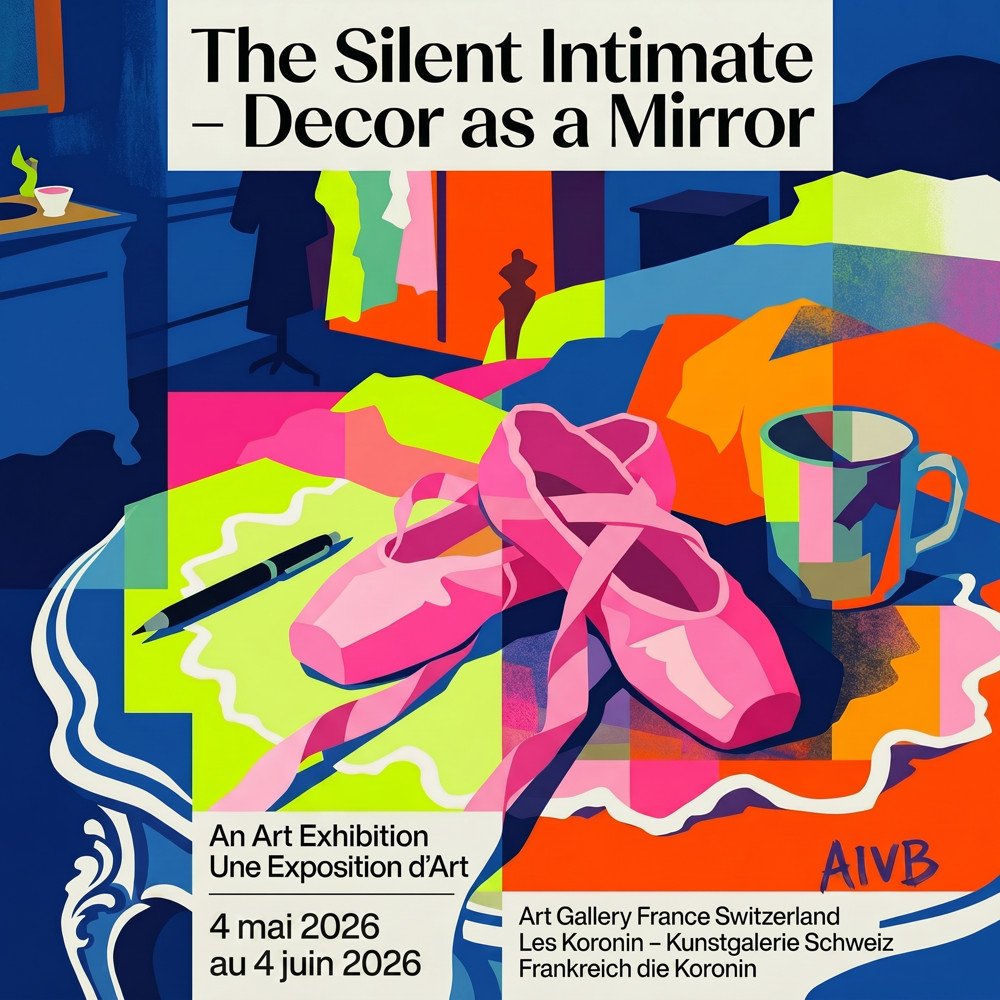
For this new exhibition, the gallery continues to explore the private worlds of the artists. Following on from the frontal self-portrait and neo-folklorism, we invite you to discover objects and places which, through vivid metaphors, express a desire to tell a deeply aesthetic story.
Why take the detour of metaphor?
-
- Avoid overt self-promotion: Talk about yourself without coming across as self-centred.
- Expressing the inexpressible: Using visual imagery to convey complex emotions.
- Encouraging identification: The everyday object becomes a universal bridge to the viewer.
- Elevating everyday life: Transforming the ordinary into a unique artistic language.
Ultimately, these works are ‘diffuse’ self-portraits. Rather than saying ‘here is my face’, the artist whispers: ‘Here is what I see, what I feel, what dwells within me.’ All of this ultimately serves to sketch out, in negative, a fascinating identity.
Our four guest artists
Four artists took up the challenge:
- Barbra le Louverot – France
- Vestara Psod – Switzerland
- Artemis Irenäus von Baste – Switzerland
- Hugo Eckener – Switzerland
barbra-le-louverot-carton-chaussures-objet-devient-miroir-galerie-koronin
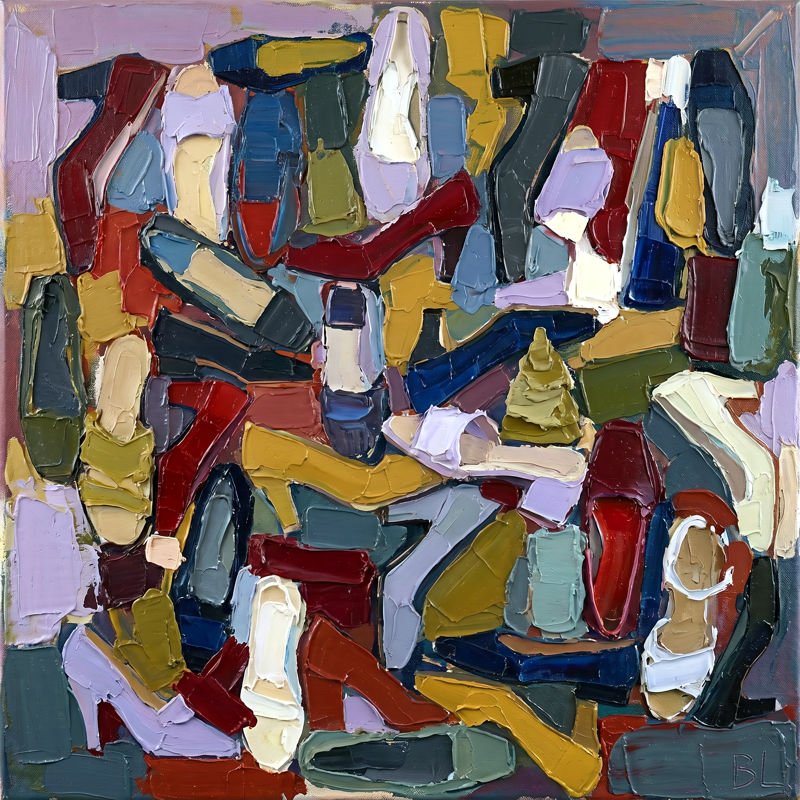
Barbara Le Louverot : Les pas de toute une vie — Huile sur toile. L’accumulation comme miroir d’une identité plurielle.
Barbra Le Louverot: the journey of a lifetime
In this textured work, Barbra Le Louverot transforms a shoe box into a veritable inventory of the soul. Whilst no faces are visible, what we do discover is a vibrant accumulation of shapes and colours that, in relief, sketch the portrait of a multifaceted identity. Thus, each shoe becomes a clue to a moment, a posture or an emotion, frozen in a dense and generous material.
Materials that evoke emotion
First and foremost, the shoe box is not merely a storage container; it becomes a veritable treasure trove of memories. Through these familiar objects, Barbra evokes the passage of time and the various ‘facets’ we wear in our daily lives. This is why this modern still life serves as a tribute to movement and lived experience.
Furthermore, the artist’s use of a palette knife lends the painting an almost sculptural quality. The blocks of colour — ranging from passionate red to melancholic lilac — do more than simply depict objects; indeed, they embody the very energy of the woman who wore them.
A self-portrait created through accumulation
Finally, why choose shoes? Because they represent our direct connection to the ground, the foundation of our ambitions and our weariness. Ultimately, by painting this seemingly disordered ‘pile’, the artist speaks to us of the complexity of being a woman and a creator, caught between elegance, everyday life and the accumulation of experiences.
Vestara Psod: the workbench as a mirror of the soul
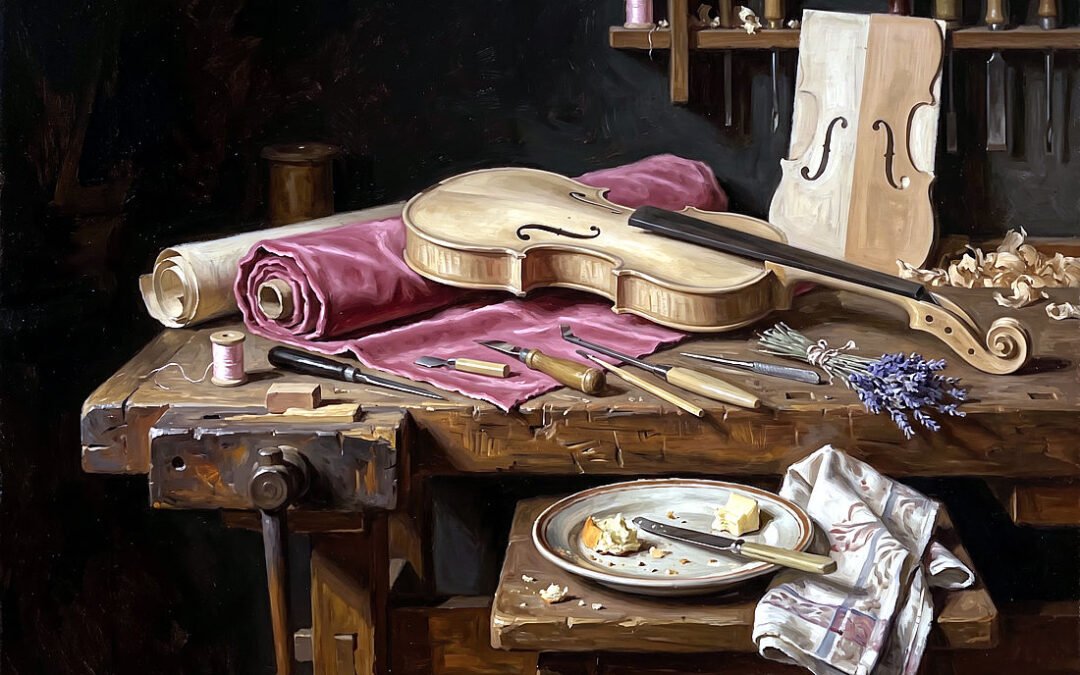
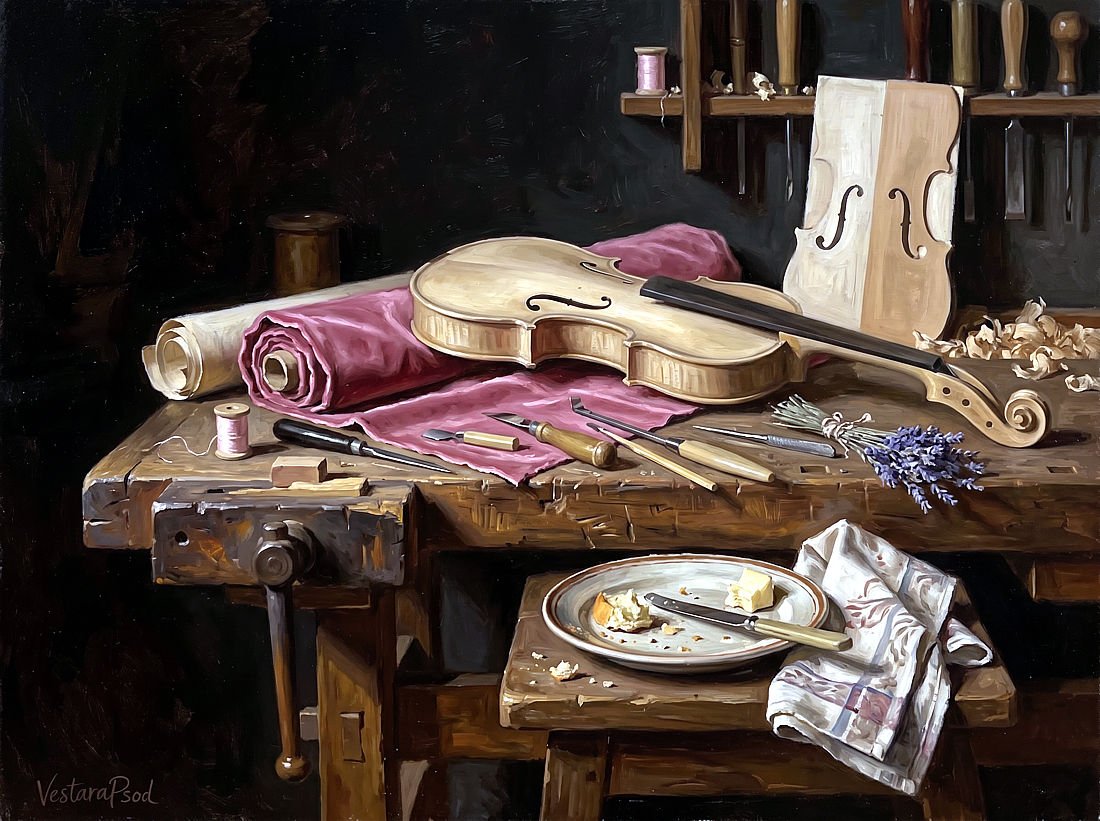
Whilst Barbra spoke to us of movement, Vestara Psod invites us into the contemplative stillness of the workshop. In this masterful work, the painting echoes a dual passion: that for the brush and that for violin-making. Indeed, it is not merely a violin in the making that we are observing, but an indirect self-portrait in which every tool and every splinter of wood speaks of patience, rigour and a love for the perfect stroke.
The sacred and the everyday: traces of a meal
On the one hand, we see the nobility of the instrument and the precision tools. On the other, the humble presence of a plate and a few crumbs on a stool breaks the solemnity of the scene. It is precisely this trace of ordinary life that humanises the artist: it reminds us that creation is a long-term endeavour, punctuated by simple moments, anchoring art in the reality of everyday life.
The harmony of materials
Moreover, the contrast between the roughness of the raw wood, the shine of the metal gouges and the softness of the shavings creates a visual symphony. In this way, the artist manages to express her own essence through the material she shapes. By choosing to paint this world, Vestara does not show us her face, but she reveals her heart and her hands, inviting us to share in the intimacy of her quest for harmony.
vestara-psod-lutherie-objet-devient-miroir-galerie-koronin
Vestara Psod : Die Werkbank als Spiegel der Seele — Huile sur toile. Entre la noblesse de la lutherie et l’humilité du quotidien.
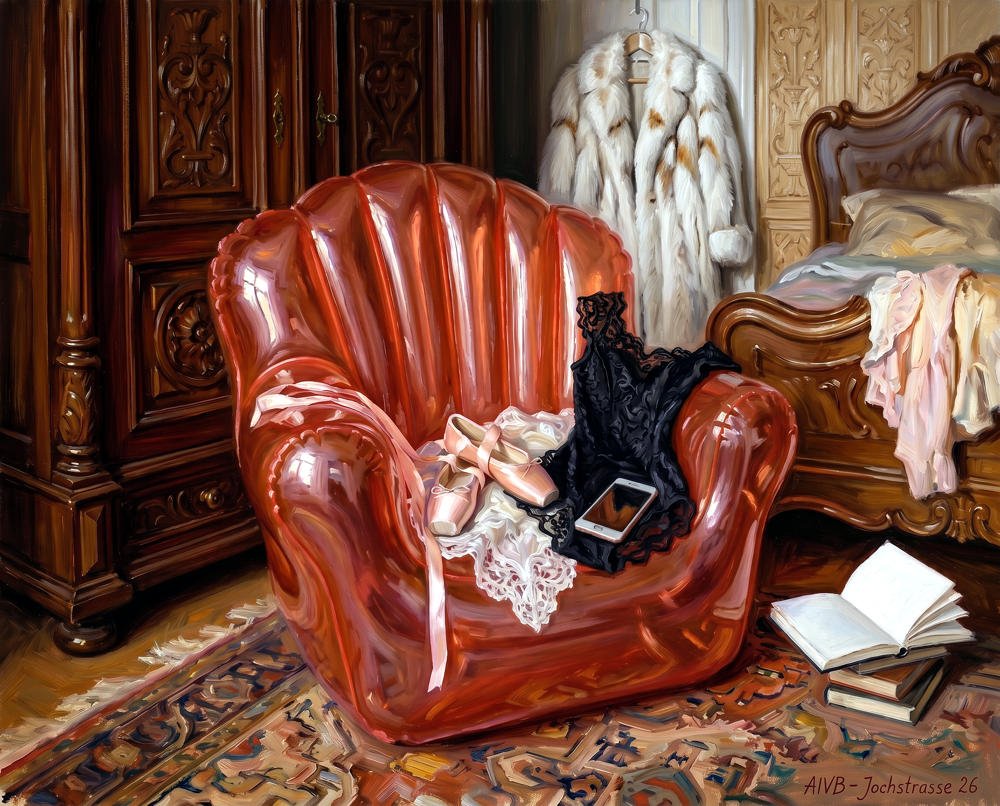
artemis-irenaus-von-baste-fauteuil-chaussons-objet-devient-miroir-galerie-koronin
Artemis Irenäus von Baste : Das Zimmer mit den intimen Spiegeln — Huile sur toile. Le dialogue entre le nomadisme moderne et la tradition jurassienne.
Artemis Irenäus von Baste: The Room of Intimate Mirrors
As we explored the intimate atmosphere of the studio, Artemis Irenäus now takes us into the sanctuary of her bedroom at the Montperreux chalet. In this work, which has a more restrained style, the artist’s presence is revealed through her favourite objects: her translucent inflatable armchair, her ballet slippers and her lace leotard. Thus, every element—from the sketchbook to the books of French literature on the floor—paints a portrait of a woman caught between two worlds: the rigour of training and the freedom of travel.
Mobile furniture as a source of stability
First and foremost, this inflatable armchair is not merely an accessory; it is her faithful companion on her travels, which she takes with her everywhere. In contrast to the massive wardrobe in the background, it embodies the artist’s lightness and modernity. Thus, by painting this object—which has become her signature — Artemis Irenäus speaks to us of her need to create her own comfort wherever she settles, turning the temporary into a home.
Discipline and the Mind: Dance and Reading
Furthermore, the presence of ballet shoes and a leotard evokes an almost ritualistic discipline, whilst the open books at the foot of the bed bear witness to her thirst for local culture. As a result, the work becomes a mental projection of her stay in the Doubs. Ultimately, Artemis Irenäus does not show us her face, but she reveals to us the delicate balance she maintains between the physical exertion of dance and the intellectual nourishment of her reading.
Hugo Eckener: the World Library
Finally, Hugo Eckener invites us into the sanctuary of thought. Whilst other artists focused on a single object or a landscape, Hugo paints an entire environment: the study-library. Indeed, in this work teeming with detail, every book, every statuette under a glass dome and every ink bottle contributes to the portrait of a scholar. It is the self-portrait of a curious mind, where the order of the bookshelves echoes the freedom of the landscape peering in through the open window.
The office as an intellectual self-portrait
First of all, the accumulation of books and collectables is no accident. On the contrary, these items form the ‘raw material’ of the artist’s identity. Thus, by painting his workspace with such precision, Hugo reveals his sources of inspiration, his ‘still travels’ and his cultural ties, transforming this room into a veritable map of his memory.
An opening to the wider world
Moreover, the contrast between the warmth of the wood in the library and the dazzling brightness of the landscape outside is striking. As a result, the window becomes a bridge between the intimacy of reflection and the immensity of the world. Ultimately, Hugo Eckener shows us that self-representation also involves revealing the balance we cultivate between our inner world and the beauty of the surrounding natural world.
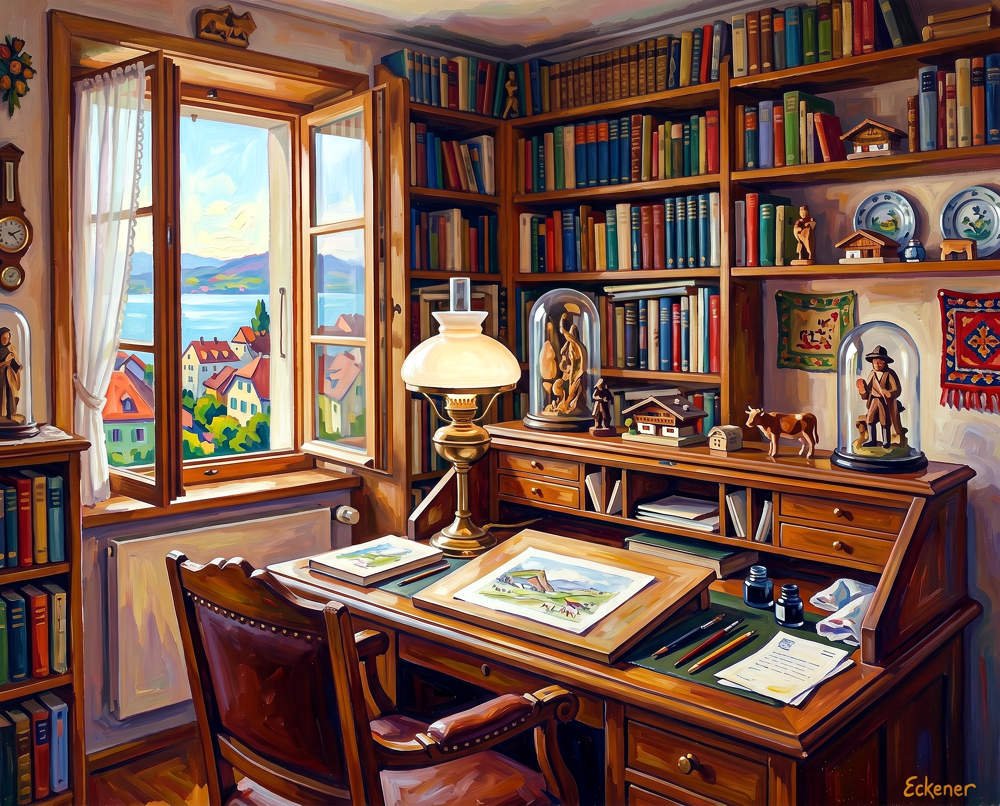
hugo-eckener-mon-bureau-objet-devient-miroir-galerie-koronin
Hugo Eckener : La bibliothèque-monde — Acrylique sur carton. L’équilibre entre le sanctuaire de la pensée et l’horizon du Léman.
Thank you for visiting
Galerie Koronin would like to thank you for joining us on this journey into the world of the indirect self-portrait. We hope these mirrors of the soul have inspired you.
Are you a creative person working in the fine arts?
We’d be delighted if you joined our Swiss–French online gallery, open 24/7 to the whole world!
Would you like to take part in our art classes?
We’d truly love to welcome you among us.

0 Comments