


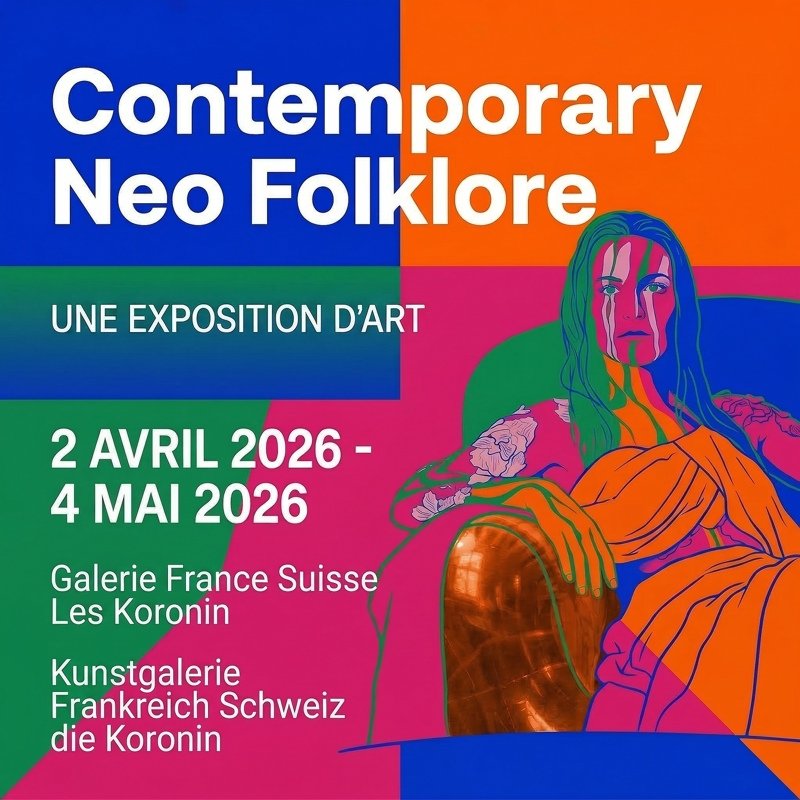
The exhibition in April 2026 draws on the imagination to shed light on contemporary neo-folklorism.
Back to pure emotion
First and foremost, the exhibition presented by the gallery builds directly on the themes explored previously. Here, we are continuing our exploration of figurative art, viewed through the eyes of four unique visual artists. For this reason, we have decided to focus on this movement, in which emotion takes precedence over realism.
Furthermore, the challenge of this selection lay in turning the new artistic conventions of our modern societies on their head. By returning art to its original purpose – to reveal and to move – we hope to offer you a respite that, in a sense, cleanses us of the world’s grime.
What is contemporary neo-folklorism?
Neo-folklorism is a movement in which emotion and atmosphere take precedence over strict realism. In this way, our artists embrace the vernacular visual language to create a fascinating contrast: they incorporate everyday objects into traditional settings. And this blend achieves such precision that the anachronism ultimately seems entirely natural.
The artists in the exhibition: a unique quartet
Under the direction of Artemis Irenäus von Baste, three perspectives complement this vision:
- Tupsa Katsiaryna Viatcheslav: the precision of the concept.
- Luca Hartmann: The poetry of reinterpreted landscapes.
- Barbara Le Louverot: the boldness of the staging.
tupsa-katsiaryna-viatcheslav-nu-samovar-neo-folklorisme
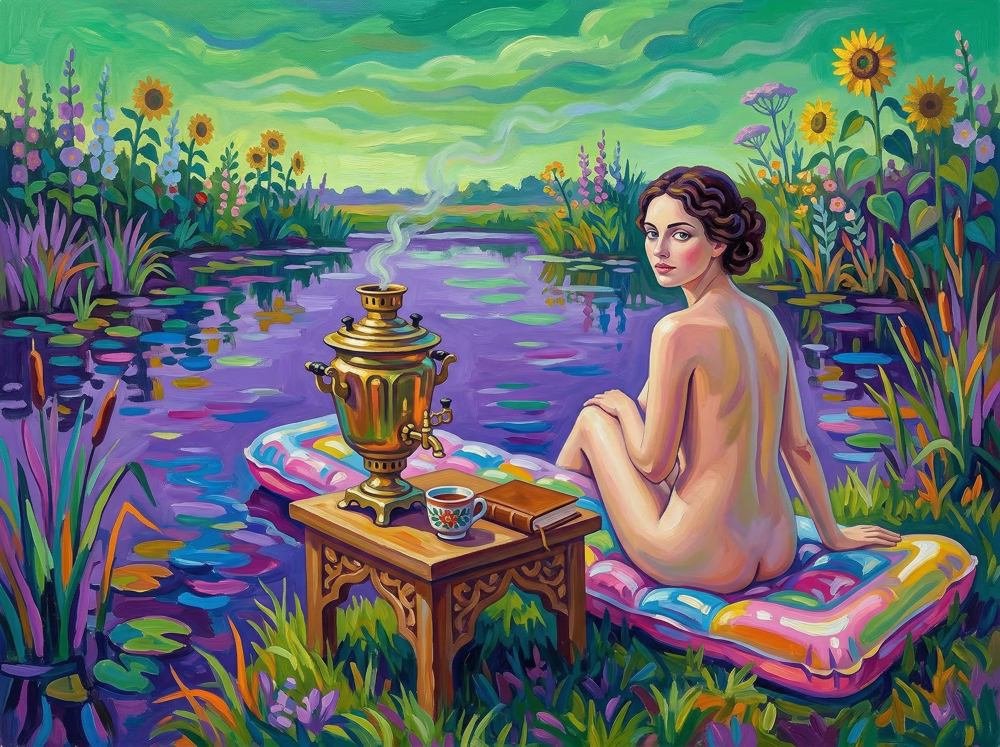
L’Heure du Thé en Icarie – Acrylique sur toile. Tupsa Katsiaryna Viatcheslav.
Tupsa Katsiaryna Viatcheslav: The Precision of the Dream
Tupsa Katsiaryna Viatcheslav is an artist with a profoundly dreamlike vision. In her works, every detail is rendered with almost photographic clarity, giving rise to worlds in which reality and fantasy merge. For this exhibition, she presents an impressive composition that embodies the essence of our curatorial vision.
Tupsa: Where worlds collide!
This painting is a masterpiece of contemporary neo-folklorism. Tupsa depicts a veritable cultural clash. Whilst the samovar evokes Slavic traditions, the air mattress transports us into the world of pop modernism. Yet the precision of her brushstrokes makes this anachronism seem entirely natural.
Luca Hartmann
Luca Hartmann is the poet of our quartet. Why? See for yourself!
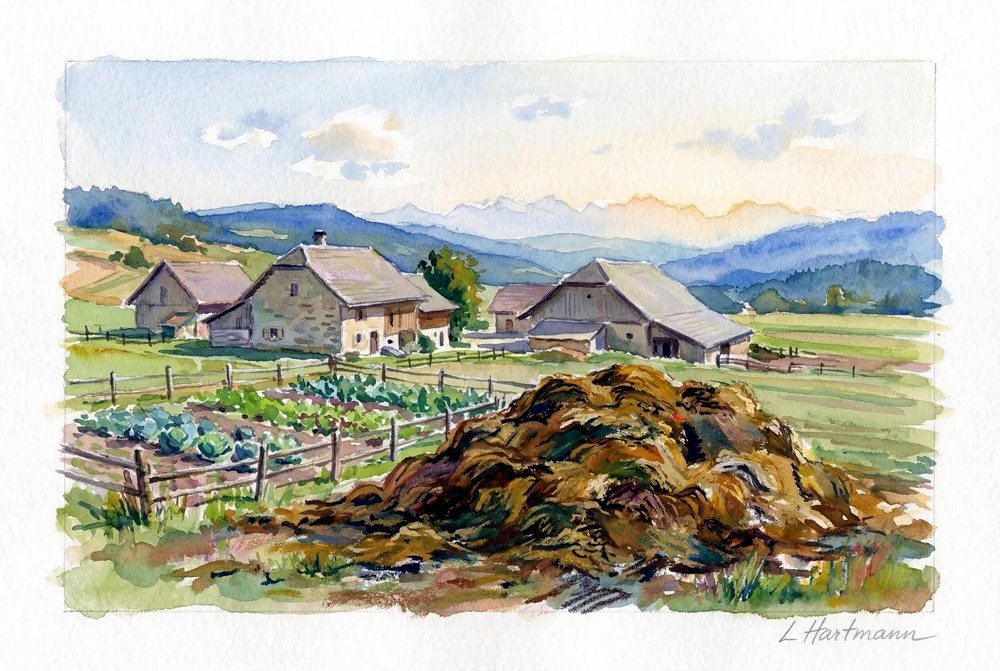
Here, he transports us to the gentle landscape of his homeland, the Canton of Vaud. His watercolour is a tribute to simple, unadulterated beauty. And with remarkably fluid brushstrokes, he captures the essence of a place, its atmosphere. For this exhibition, he has therefore gifted us with a work that – as with Tupsa – brings to life the serenity of a fleeting moment.
Luca: The timeless beauty of the region
In this watercolour, Luca embodies neo-folklorism through a poetic reinterpretation of the traditional landscape.
Here, Swiss folklore comes to life: the farmhouse with its stone walls and tiled roof, the steaming haystack in the foreground. It is the rustic visual language of the countryside that we love. Yet Luca lends the whole scene a gentle modernity: the perfectly shaped round bales of hay in the field (an anachronism compared to the old farmhouse) and, above all, this dreamlike colour palette with the lilac-pink sky and the vibrant wildflowers. This subtle shift, this way of refining reality through colour and light, is the essence of our curatorial considerations.
It is a work that cleanses us of the world’s grime, reconnecting us with the earth’s goodness.
luca-hartmann-aquarelle-jura-foin-suisse-neo-folklorisme.jpg
Luca Hartmann – Le Parfum de la Terre – Aquarelle et pastel – 2025
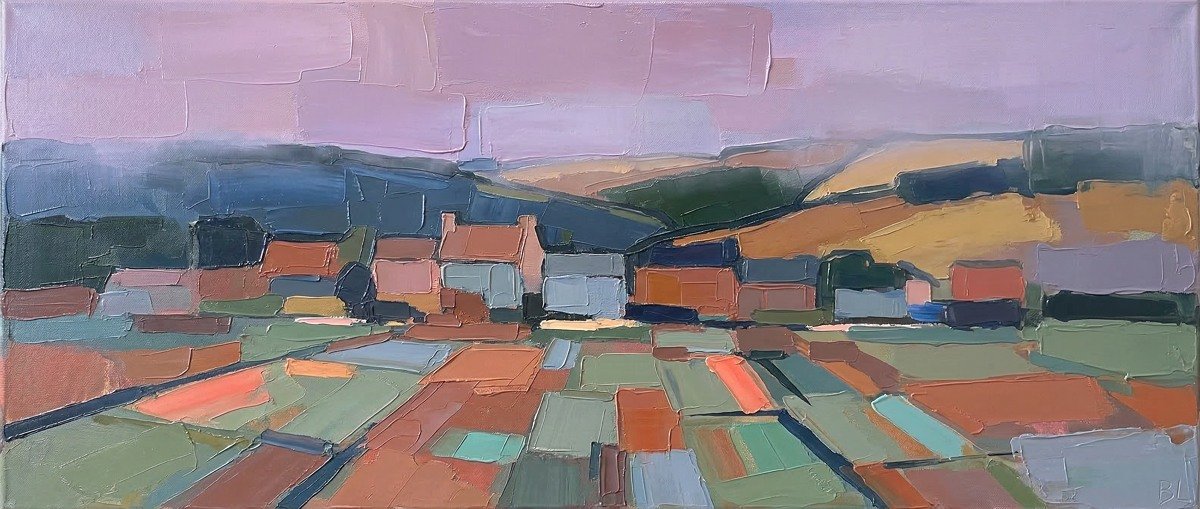
barbara-le-louverot-jura-matinal-neo-folklorisme.jpg
Jura Matinal – Huile sur toile. Barbara Le Louverot exprime ici la vibration des terres jurassiennes.
Barbara Le Louverot
A Fruitful Exile
Barbara, a former Parisian who has now settled in the stunning Jura countryside, finds new artistic inspiration here. Far from the hustle and bustle of city life, in the soil of Franche-Comté, she has discovered a raw material that she literally shapes with her oil paints.
Barbara Le Louverot: The Jura transformed by neo-folklorism
Here we see the discrepancy typical of neo-folklorism: the traditional structure of a village (folklore) is rendered using a bold colour palette and an almost abstract texture (modernism). As a result, the purple sky and these mosaic-like fields create an environment that feels both idyllic and otherworldly: serenity.
Artemis Irenäus von Baste:
Art as an Everyday Ritual.
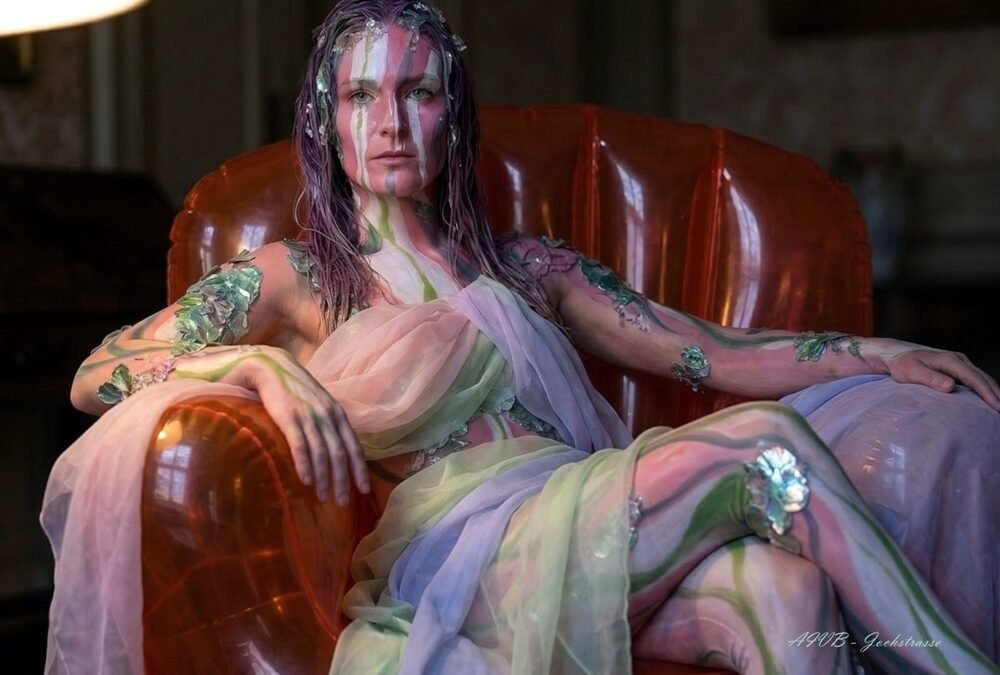
Finally, Artemis Irenäus brings this journey to a close. On the one hand, she demonstrates enormous patience through her costumes. On the other hand, she incorporates everyday objects, such as her inflatable armchair, to create a contrast. Ultimately, this fusion of body and synthetic object perfectly encapsulates our theme. For her, art is not simply the creation of objects, but rather a holistic experience. Thus, our multidisciplinary artist stages herself in Chur, blurring the boundary between her work and her own person.
Consequently, this photographic work, 95% of which is authentic, is the result of a quest for harmony between her body and her surroundings, which she idealises through her lens.
A modern-day “Birth of Venus” on an inflatable armchair
In this self-portrait, Artemis Irenäus offers a bold reinterpretation of conventional depictions of nymphs or mythological figures. Yet instead of a shell or a traditional rural setting (folklore), she chooses an everyday, pop-inspired and colourful object: her favourite armchair (modernity).
This contrast creates a fascinating resonance. The costume, a true living work of art that mimics vegetation, seems to merge with the object’s vibrating plastic. This contrast between organic vulnerability and synthetic materiality is the essence of contemporary neo-folklorism. By presenting herself with such authenticity in her hometown of Chur, Artemis Irenäus offers us an image that is ‘given to be seen’, in which anachronism becomes the catalyst for a new beauty.
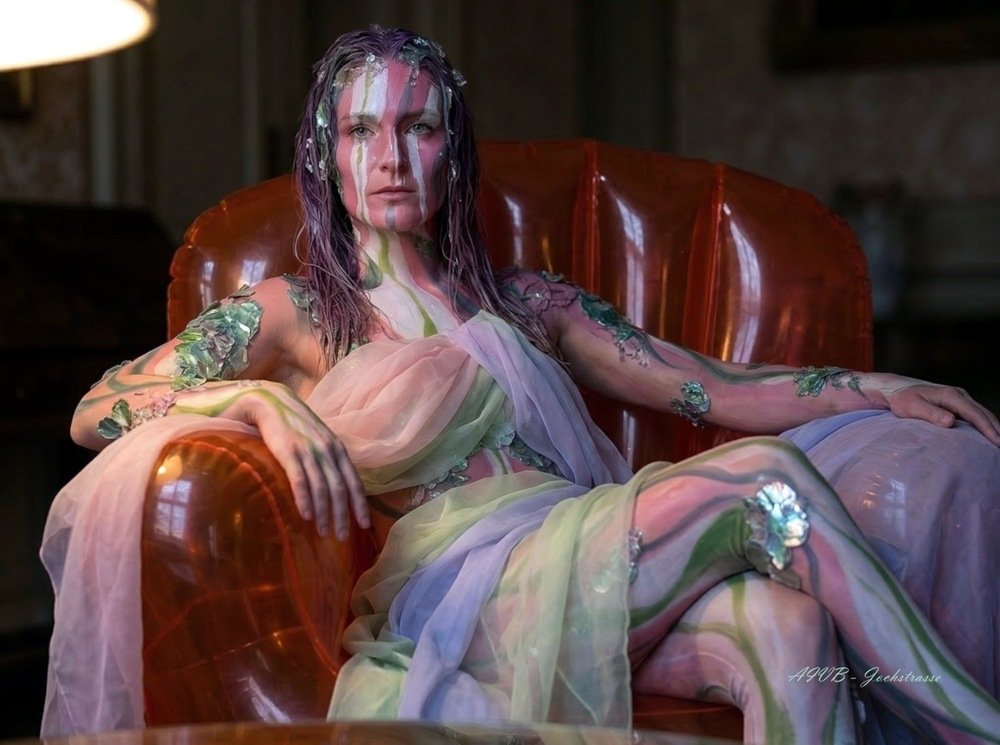
artemis-irenaus-von-baste-chur-neo-folklorisme
La Naissance de la Nymphe Gonflable – Autoportrait photographique. Artemis Irenäus von Baste.
First of all, we would like to thank you very much for taking the time to discover this world of contemporary neo-folklorism. It is thanks to your curiosity that Galerie Koronin can continue to promote this artistic dialogue between tradition and modernity.
If any of the works have particularly caught your eye, please do not hesitate to contact us to find out more about the artists’ creative process. We also warmly invite you to share your thoughts in the comments. Finally, we hope that you have enjoyed this spring experience as much as we enjoyed preparing this exhibition.
We look forward to seeing you again soon at our next artistic stops.

0 Comments