


« Me, a woman » : when female identity is asserted through gesture and material
Conversation between Anja Dallenbach and Ayla Woss.
Dance and colour: two weapons, one truth
This February 2026, the gallery is offering more than just an encounter between Switzerland and Bavaria. It is a fruitful collision between paintbrush and chisel. When Ayla Woss freezes a dancer in mid-air to assert her freedom, Anja Dallenbach responds with explosions of colour that celebrate interdependence. Together, they prove that if men have never understood women, it is perhaps because only women hold the keys to their own mystery.
Faced with the rise of masculinism in the 21st century and the return of ideologies that relegate women to a subordinate role, two visual artists from our gallery have decided to break the silence. Anja Dallenbach, a Swiss abstract painter, and Ayla Woss, a Bavarian sculptor, explore a common theme: « Moi, une femme ».
The right to define oneself: the legacy of Virginia Woolf
Thirty years separate Ayla Woss from Anja Dallenbach. Yet their observations are identical. They recall the words of Virginia Woolf, who already denounced a glaring anomaly in her novels: in London libraries at the beginning of the 20th century, out of every hundred books written by scientists, ninety were about animals and only ten were about women.
Anja and Ayla emphasise that men have for too long granted themselves the right to describe femininity. Men legislate on women’s bodies and define their limits. But men are not women. And if the greatest literary figures have often admitted that men understand nothing about the “dark continent” of femininity, will the two sexes ever be able to agree? Nothing is less certain. It is in this uncertainty that their art is born.
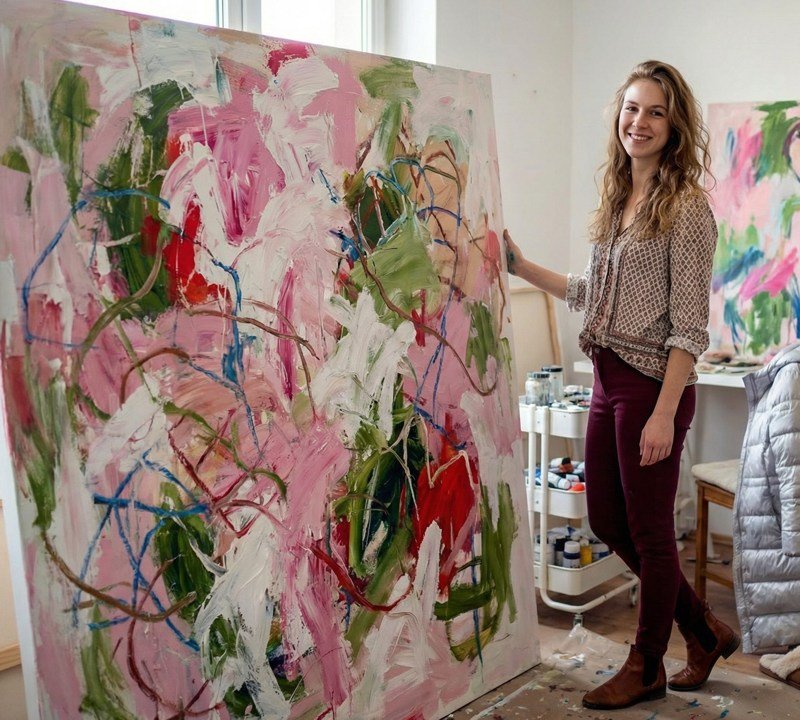
Anja Dallenbach
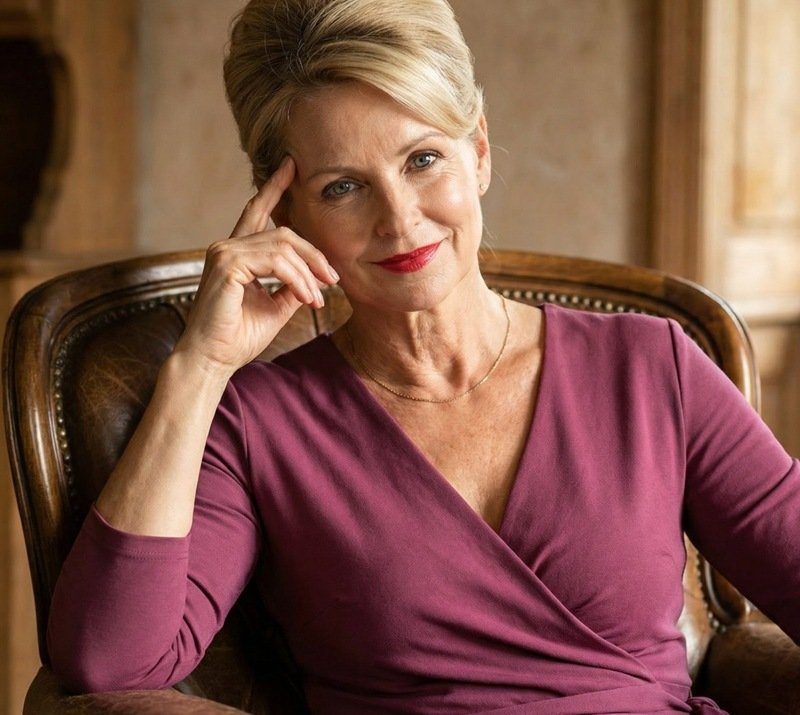
Ayla Woss
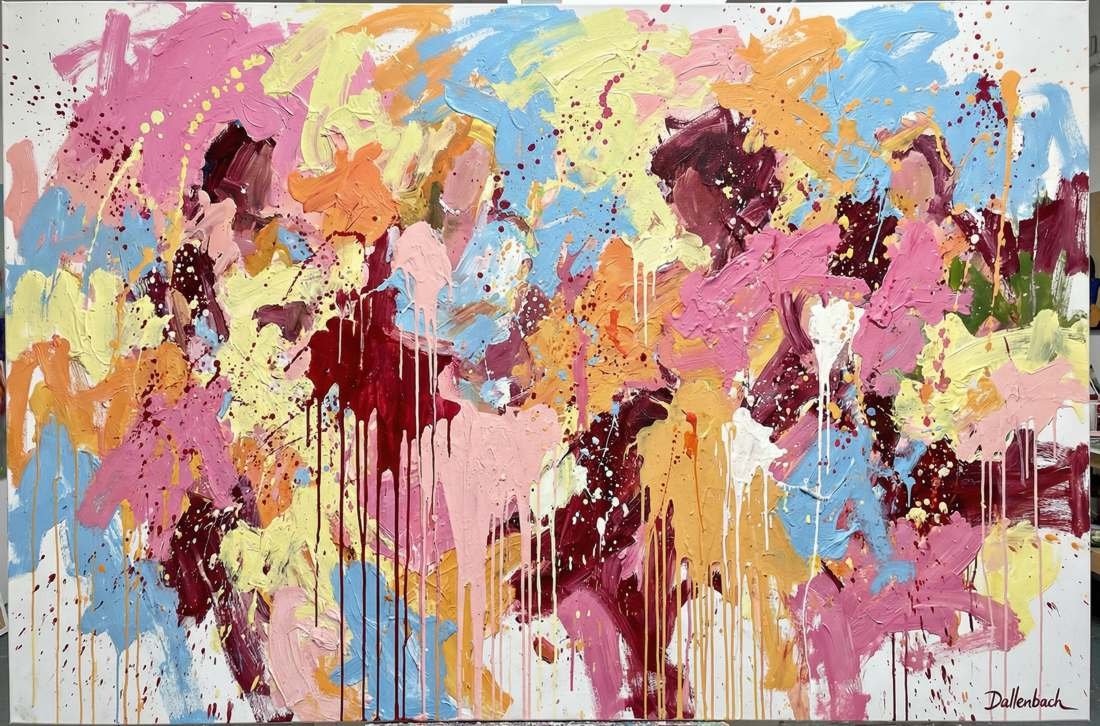
anja-dallenbach-die-vielfalt-ölgemälde-auf-leinwand-ca.-120x65cm-2026
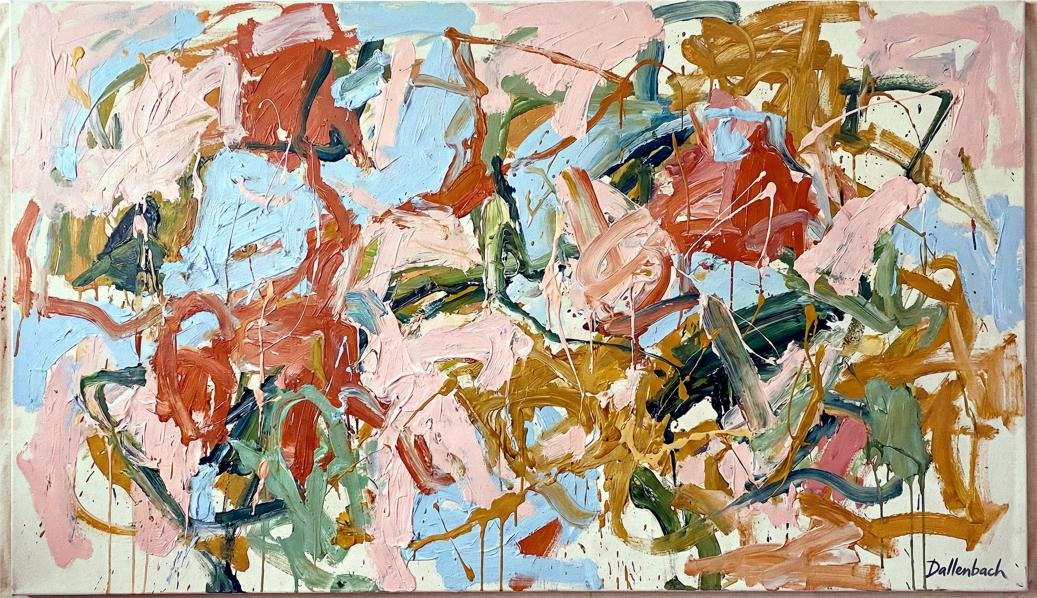
Anja Dallenbach, «Die Vielfalt», Ölgemälde auf Leinwand, ca. 120 x 65 cm, 2026
anja-dallenbach-ich-eine-frau-nummer-2-serie-von-acht-gemalden-ol-auf-leinwand-2026
Anja Dallenbach « Ich, eine Frau Nummer 2 », Serie von acht Gemälden, ol auf Leinwand – 2025
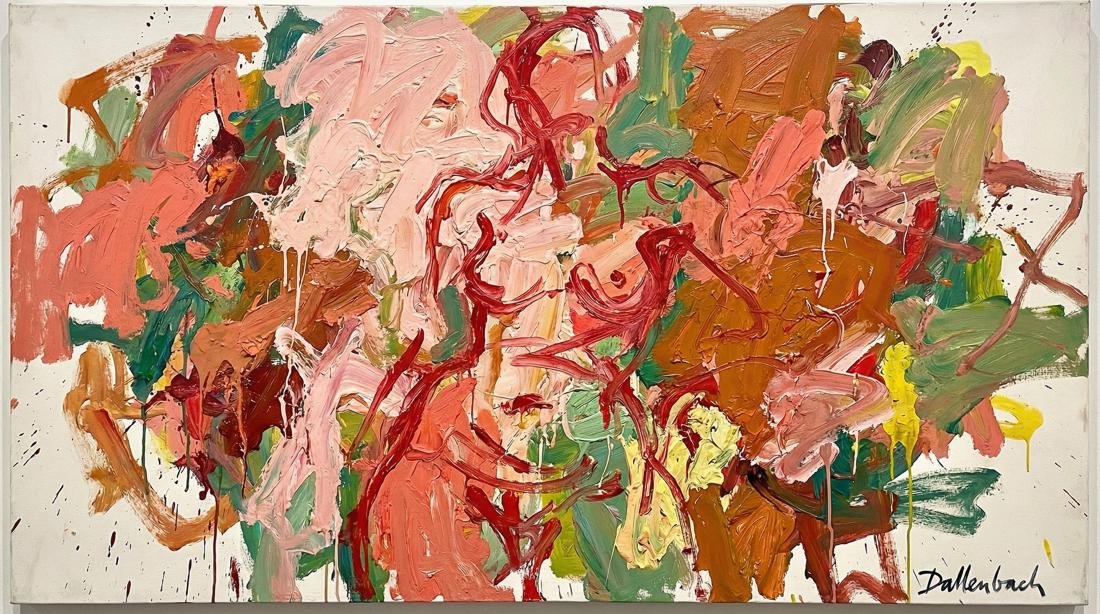
anja-dallenbach-dieses-thema-gehört-nur-den-frauen-ölgemälde-auf-leinwand-ca.-120x60cm-2025
Anja Dallenbach, «Dieses Thema gehört nur den Frauen», Ölgemälde auf Leinwand, ca.120x60cm – 2025

anja-dallenbach-ohne-titel-ölgemälde-auf-leinwand-ca.-140x80cm-2026
Moi, une femme n°3 : L’éclosion du soi. Huile sur toile.
Anja Dallenbach: female identity through abstraction
In her paintings, Anja Dallenbach expresses her feelings as a woman through an explosion of colours and textures. What she feels, her psychological life, her pure joy of existence.
Thus, she does not seek to represent or explain female identity; she embodies it. Her paintings reflect what makes up her identity: a vision of the world where women are not a function, but a network of living, vibrant connections.
Anja Dallenbach, « Me, a woman »
In these masterful paintings, Anja Dallenbach rejects the isolation of the female figure. The silhouettes, barely sketched with generous strokes of oil paint, seem to dance in a space where colour becomes pure emotion. This work is a direct visual response to Virginia Woolf’s text, in which men seek to classify and define women as objects of study, while Anja responds with movement and multiplicity:
-
Dripping : Symbolises the fluidity of identity, what escapes us and what connects us to others.
-
Impasto (thickness) : Represents self-assertion, the physical and “embodied” presence of women who no longer ask for permission to exist.
-
The Palette : The contrast between deep burgundy tones and bright yellows evokes the duality between struggle (resistance to masculism) and the joy of being oneself.
At Ayla Woss’s, it’s quite the opposite. Let’s go and see…
Ayla Woss: dance as resistance
Seeing Ayla’s sculpture alongside Anja’s paintings gives our exhibition an almost palpable dimension. We move from chromatic and psychological explosion to Ayla’s physical and historical tension.
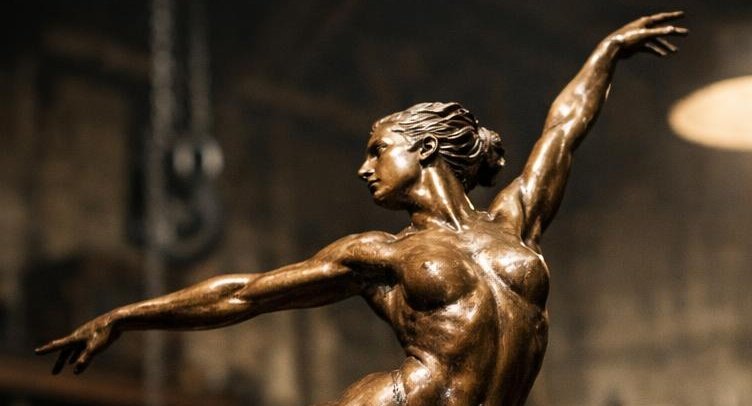
Ayla Woss’s bronze sculptures capture the movement of the living body. Her dancers evolve on the precarious borderline of imbalance, between technical effort and aesthetic research. Each movement is a political act: a way of reclaiming a body that has been described and legislated by others for too long.
Dance is not a question of social status or conservatory diplomas. It is a matter of intrinsic femininity, of female identity itself.
Ayla Woss, « Me, a woman »
Ayla sculpts the body in action. This piece responds to Virginia Woolf’s text with physical evidence:
-
The Material (Bronze) : Contrary to the idea of fragile femininity, Ayla’s bronze is enduring and solid. It is an affirmation of presence that spans the centuries.
-
The Pose : The deliberate imbalance shows that women are not static objects to be observed, but subjects in constant motion, seeking their own harmony.
-
The Face : Serenity combined with concentration evokes that “fulfilment” you mentioned in your draft, far removed from the dictates of age or social status.
Throughout history, women have danced to express themselves and have fun. It is an instinct that even the Holy Inquisition and its sadistic witch hunts (between 1580 and 1630) could not extinguish. Despite religious prohibitions that still exist today in certain countries, including Iran under the mullahs (where women are forbidden to dance in public), Ayla Woss continues to sculpt dance. Because dancing is an affirmation of freedom.
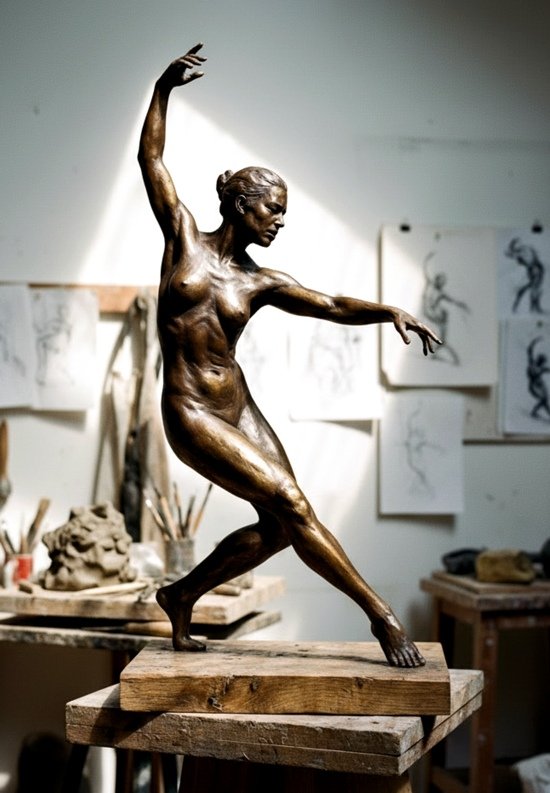
Ohne Titel 10 figurative Skulptur aus Bronze, Tanzbewegung – Ayla Woss – 2025
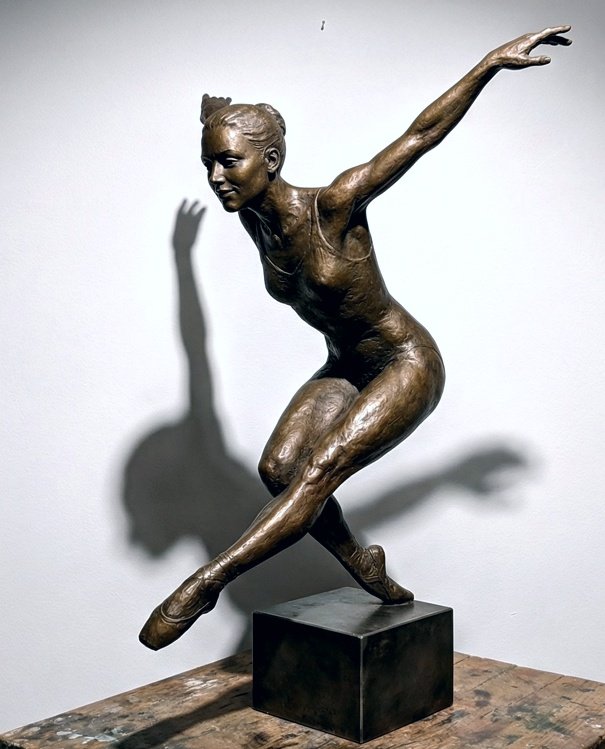
Ohne Titel 6 figurative Skulptur aus Bronze, Tanzbewegung – Ayla Woss – 2024
Ohne Titel 6 figurative Skulptur aus Bronze, Tanzbewegung – Ayla Woss – 2024
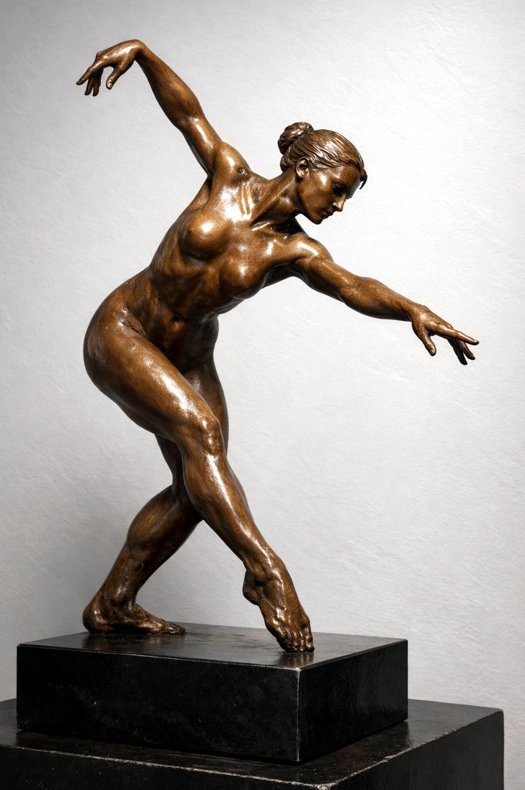
Ohne Titel 4 figurative Skulptur aus Bronze, Tanzbewegung – Ayla Woss – 2019
« Ohne Titel 4 » figurative Skulptur aus Bronze, Tanzbewegung – Ayla Woss – 2019
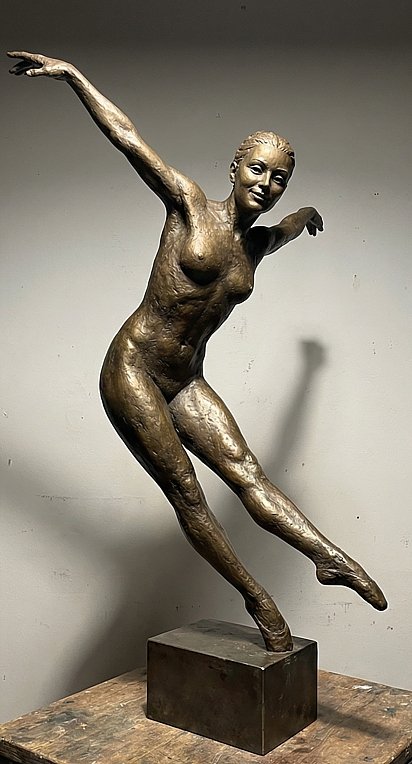
Ohne Titel 5 figurative Skulptur aus Bronze, Tanzbewegung – Ayla Woss – 2023
« Ohne Titel 5 » figurative Skulptur aus Bronze, Tanzbewegung – Ayla Woss – 2023
Two mediums, one voice
By bringing together Anja Dallenbach’s vibrant oils and Ayla Woss’s tense bronzes, the gallery offers much more than an exhibition: it offers a manifesto.
Where Anja uses dripping and impasto to express the fluidity of inner identity, Ayla uses the resistance of metal to anchor women in history and space. This is how, thirty years apart, both artists respond to Woolf’s invitation: to stop being “described” by others and finally tell their own stories.
Me, a woman. Three words that, under Anja’s brushes or Ayla’s hands, become a universal cry for freedom.
Kind regards.
Vous êtes une personne créative, qui travaille dans les arts plastiques ?
Nous serions ravis que vous profitiez de notre vitrine en ligne franco-suisse, ouverte au monde entier 24h/24 !
Peut-être souhaitez-vous rejoindre nos cours d’art ?
Nous serions sincèrement heureux de vous compter parmi nous.

0 Comments